
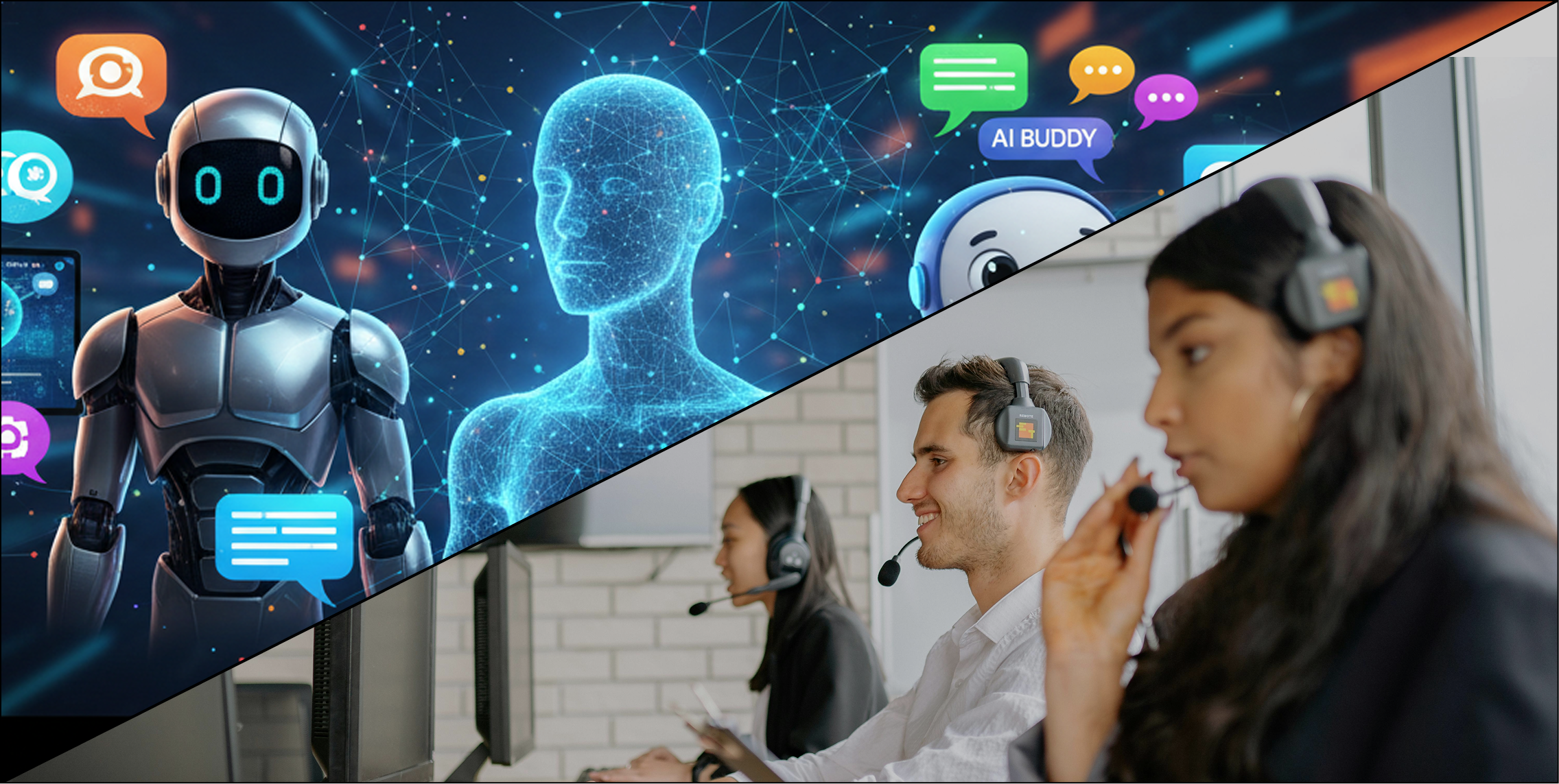
Is it the satisfaction you feel when you receive the right answer or solution? Is it the emotional, genuine guidance you get along the way? Or, most importantly, is it the quality of the connection you build with the person helping you? Modern technology has pushed companies to reduce costs by relying on AI chatbots and even AI-powered callers designed to address customer questions and concerns. While this may represent the future of customer service, it also poses risks for the many individuals and families whose livelihoods depend on this work.
What Are AI Agents and Chatbots?
Artificial intelligence (AI) continues to evolve as tech firms improve systems for speed, workflow optimization, and task efficiency. In customer service, AI is reshaping the landscape through two main tools: AI agents and chatbots. AI agents are autonomous, self‑service tools designed to perform specific tasks and respond to particular situations. They take in information, process it, and generate actions or solutions based on the problem at hand. These agents often handle repetitive or undesirable tasks so that human representatives can focus on more complex issues. Examples include automatically scheduling meetings, drafting emails, managing content, and other automated workflows. With generative AI systems such as large language models (LLMs) and natural language processing (NLP), a single prompt can help an AI agent understand a situation and produce a solution. Chatbots, on the other hand, simulate human conversation through text or voice. They rely primarily on NLP and decision trees to provide automated responses. Think of a chatbot as a branching road: if a user gives a certain response, the chatbot guides them down one path; if the response changes, the path changes too. Chatbots are typically equipped with enough data to answer simple, repetitive questions and ensure customers receive quick, basic support.

Importance of Human Customer Service
Human customer service fosters genuine connection — an interaction not dictated by algorithms or predetermined inputs. Humans draw on personal experience, emotional intelligence, and intuition to deliver fast, personalized, empathetic responses that help customers solve problems in unique ways. Although businesses were once skeptical of AI, the rise of affordable tools has made them more comfortable replacing human labor with automated systems. Yet human customer service remains essential. Strong human‑to‑human interactions increase retention, build trust, and often lead to higher satisfaction than AI alone. It also signals that a business values people over efficiency. Most importantly, having a human who listens, understands, and responds to a customer's specific needs can make all the difference in resolving an issue effectively.

How Does AI Impact Human Customer Service?
AI adoption has already displaced many workers in customer service roles. In the United States, roughly 3 million people work in call centers. Companies like Klarna have begun replacing large portions of their workforce — in 2024, the company laid off about 700 of its 3,000 customer service agents and replaced them with AI systems. Economists estimate that AI could increase labor productivity by around 15% once widely adopted. Out of 800 occupations studied, researchers predict 6–7% job displacement. But what does this mean for unemployment? According to Goldman Sachs Research, the long‑term impact remains uncertain. Historically, technological advancements have created new types of jobs and increased overall economic output. For example, in 1940, 85% of employment growth came from technology‑driven roles. However, as seen with Klarna, displacement can still spike in the short term — especially for workers who lack training in new technologies.

Final Thoughts: The Future of Customer Service
The future of customer service will not be defined by choosing either AI chatbots or human support, but by how effectively businesses blend the strengths of both. AI will continue to evolve, offering speed, scalability, and efficiency that no human workforce can match. It will handle routine tasks, streamline workflows, and reduce operational costs — all valuable contributions to modern business. But efficiency alone does not build loyalty. Customers remember how they were treated, how they were understood, and how they were made to feel. That emotional intelligence — the ability to listen, empathize, and adapt — remains uniquely human. As companies push toward automation, the risk is not just job displacement; it's the erosion of genuine connection in moments when people need it most. The challenge ahead is finding balance. Businesses that rely solely on automation may save money in the short term but risk alienating customers who crave authenticity. Those that invest in human expertise while leveraging AI for support will likely create the most resilient, trusted service models. Customer service is ultimately about relationships. AI can enhance those relationships, but it cannot replace the human capacity for empathy, nuance, and understanding. The companies that recognize this — and design their systems accordingly — will shape the future of customer care.
Key Takeaways
Great customer service is defined by connection, not just solutions — satisfaction comes from feeling understood, supported, and genuinely cared for, not simply receiving the correct answer. AI agents and chatbots are transforming customer service, offering speed, automation, and efficiency for routine tasks that don't require human judgment or emotional intelligence. AI tools excel at structured, repetitive workflows, such as scheduling, content generation, and guiding users through predictable decision trees. Human support remains irreplaceable for complex, emotional, or nuanced interactions, where empathy, intuition, and personalized problem‑solving matter most. Businesses risk losing customer trust if they rely too heavily on automation, especially when customers need reassurance, clarity, or human understanding. AI adoption is already reshaping the workforce, with companies like Klarna replacing hundreds of customer service roles — a trend that raises concerns about job displacement and the need for retraining. Economists predict both productivity gains and workforce disruption, but the long‑term impact on employment remains uncertain as new technology‑driven roles continue to emerge. The future of customer service depends on balance, blending AI's efficiency with the emotional intelligence and adaptability only humans can provide. Companies that prioritize human connection while leveraging AI strategically will build stronger relationships, higher loyalty, and more resilient service models.
Sources & References
Found this article helpful? Share it with your network!